Service Area
Oil-to-Heat-Pump Conversions and Ducted Installs in Lake City & Northgate, WA
Last Updated
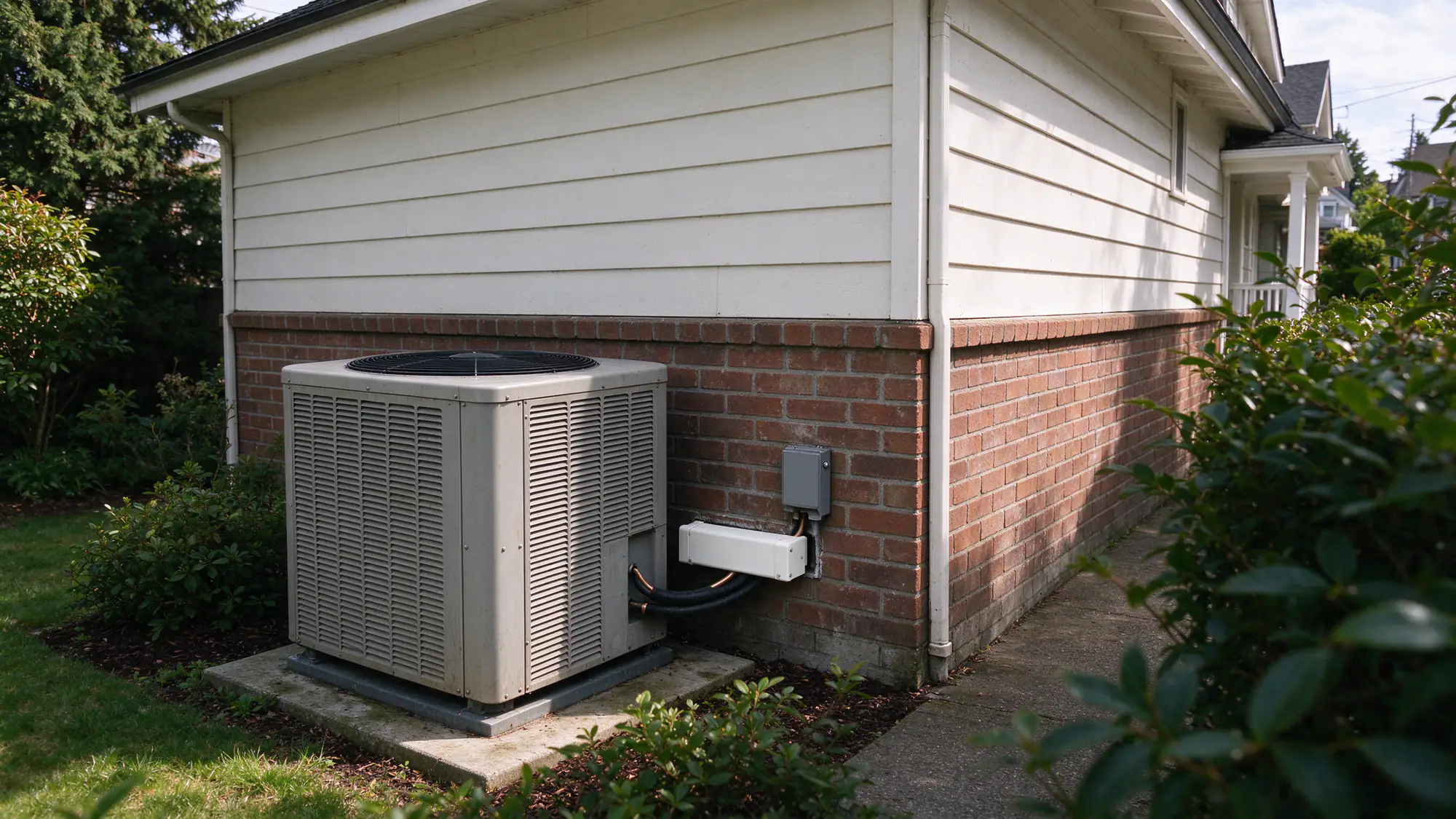
Heat pump installation in Lake City and Northgate is mostly a conversion story: a postwar house with a forced-air furnace, often still burning oil, moving to a ducted heat pump on the ducts it already has. The Seattle Heat Pump Company plans and manages these projects from Matthews Beach and Cedar Park west to Haller Lake and Licton Springs, with the work carried out by licensed and insured contractors.
The question most owners here are really asking is narrower than “should I get a heat pump.” It is how to sequence the conversion so the tank, the rebates and the house all line up.
Postwar housing changes the starting point
These two districts are among the youngest in Seattle. Only about 8.7% of Lake City’s homes and 9.4% of Northgate’s predate 1940, according to Census estimates, compared with more than a third in Capitol Hill and Wallingford. Roughly 40% of Lake City’s housing went up before 1960, which puts a large share of the stock in the postwar decades when central forced-air heating became the norm.
That matters for the equipment decision. A house built around a furnace and a duct system can usually take a ducted heat pump without the duct redesign that pre-war homes often need. The supply runs reach every room, the returns exist, and the air handler can often go where the furnace sat. Where the original ducts are intact, a heat pump on existing ductwork is the natural first option to test.
Permit activity matches that picture. Over the latest three years of records, City of Seattle open data shows 1,056 single-family heat pump trade permits in Lake City and 1,063 in Northgate, 2,119 between them. About 27% of Lake City’s permits and 22% of Northgate’s mention ducted equipment.
Where the oil homes are
Census estimates put about 833 oil-heated households in Lake City, 5.8% of the district, and about 530 in Northgate. Only West Seattle, Northeast Seattle and Ballard have more. Each of those homes has a tank somewhere, usually buried in the yard with a fill pipe near the foundation, sometimes a basement tank.
An oil to heat pump conversion handles both halves. The oil burner and furnace come out, an electric air handler or a heat pump coil takes their place, and a new outdoor unit connects through a refrigerant line set. The tank gets decommissioned under a Seattle Fire Department permit, which is issued to an ICC-certified decommissioner, not to the homeowner or the HVAC contractor. The oil tank decommissioning page covers the removal-versus-fill decision in detail.
Getting the sequence right
The order of operations decides how much of the available money you keep. Three programs can touch a Lake City or Northgate conversion and each has its own trigger.
Seattle Clean Heat takes $2,000 off a qualifying Mitsubishi Electric heat pump installed by a participating contractor in a Seattle home currently heated with oil. Households between 81% and 150% of area median income can add $4,000, for installations completed within the program’s current funding period. Income-eligible households below that range can get a no-cost conversion through the Office of Housing’s HomeWise program. Because the rebate depends on the house still heating with oil, it fits best when the conversion and tank work are planned together.
City Light’s contractor discount adds $300 or $600 depending on the equipment’s efficiency tier, one system per home, paid through participating distributors and contractors. Ask that it appear on the invoice.
PLIA’s Heating Oil Loan and Grant program can fund up to $75,000 per project for tank cleanup and related work, with no income limit. PLIA has to approve the project before any tank work starts. Decommissioning first and applying afterward forfeits it. PLIA takes applications in a limited window each year, usually in late fall, so check PLIA’s site for the current dates. The state’s old heating oil insurance no longer covers new claims; its policy expired June 30, 2025.
The rebate guide keeps the current amounts in one place, and the oil conversion cost guide shows how the heat pump and tank ranges add together.
Map out your conversion before the tank is touchedAn assessment covers the load, the ducts, the panel and where the tank sits.
Get an EstimateWhat an assessment checks in these houses
The load calculation comes first, done room by room for Seattle’s 24°F design day under ACCA Manual J. Many postwar houses have had attic insulation, new windows or a finished basement added since the oil furnace was sized, so the right heat pump is often smaller than the furnace nameplate suggests. The Manual J sizing guide explains why oversizing costs comfort as well as money.
The ducts get a static pressure reading with the blower running. A heat pump moves more air than an oil furnace to deliver the same heat, because its supply air is cooler. Single central returns and undersized return grilles are the usual limit in houses of this era, and both are fixable without replacing the whole system.
The electrical panel decides more of the budget here than owners expect. An oil-heated house never needed a large electric heating load, and the heat pump plus its backup heat strips add one. Some panels have room; others need a service upgrade. The panel requirements guide walks through how that gets calculated.
Then the outdoor unit location. Seattle limits residential noise at the property line to 55 dBA by day and 45 dBA at night, and a side-yard location triggers a noise review. A rear-yard pad usually clears the limit; a narrow side yard may need a quieter model, a barrier or a different spot.
Permits and the order of work
Inside Seattle, the split system needs a refrigeration permit pulled by a licensed refrigeration contractor, plus an electrical permit, and a mechanical permit when the furnace is replaced. Inspectors check the work at cover and final. The tank permit runs separately through the fire department, and the decommissioner files a report within 30 days of the work.
A typical sequence runs: assessment, rebate and PLIA decisions, permits, heat pump installation, commissioning, then tank decommissioning once the oil system is shut down for good. Commissioning verifies airflow, refrigerant charge, defrost operation and the backup heat controls, which Seattle’s energy code requires to keep electric strips off above 40°F outdoors.
Running costs on City Light
Lake City and Northgate buy electricity from Seattle City Light at 13.38 cents per kWh. No official Washington series tracks heating oil prices, so a fair oil comparison has to use your own delivery receipts. Against gas the math is clearer: a heat pump beats a 95% efficient gas furnace on energy cost once it averages a coefficient of performance of about 2.2 on City Light’s Seattle rate, which modern units clear through most of a Seattle winter. For the gas-heated half of these districts, a furnace to heat pump conversion follows the same assessment path, minus the tank.
Neighboring areas share much of this pattern. Northeast Seattle has the city’s largest oil-heated share and older houses on average, while Shoreline and Lake Forest Park sit just north on City Light’s suburban rate and outside Seattle Clean Heat. Greenwood and Northwest Seattle lie to the west across I-5.
Around Lake City & Northgate
Neighborhoods
- Matthews Beach
- Victory Heights
- Olympic Hills
- Cedar Park
- Maple Leaf
- Haller Lake
- Pinehurst
- Licton Springs
- Northgate Station
- Matthews Beach Park
- Thornton Creek
- Maple Leaf Reservoir Park
- I-5
- Lake City Way NE (SR 522)
- NE Northgate Way
- 35th Ave NE
- NE 125th St
- Seattle City Light (electric), PSE (gas)
- Seattle Department of Construction & Inspections
Services in Lake City & Northgate
Lake City & Northgate heat pump questions
What does an oil-to-heat-pump conversion cost in Lake City or Northgate?
There is no separate price for these neighborhoods. A ducted heat pump on usable ducts typically runs about $6,700 to $20,000 in the Seattle area. Filling a clean tank in place adds roughly $700 to $3,000 plus the $184 fire permit, and a panel upgrade, if needed, about $1,333 to $4,500. These are budgeting ranges, not quotes.
My house was built in the 1950s. Is that an easy conversion?
It is often a simpler one than a pre-war house, because many postwar homes were built around a forced-air furnace and a duct system. Simpler is not automatic, though. The ducts still need a static pressure test, the panel needs room for the heat pump circuit, and the tank needs its own permit and decommissioner.
Should I decommission the oil tank before or after the heat pump goes in?
Usually as part of the same project, after the heat pump is running so the house is never without heat. If you plan to apply for PLIA's Heating Oil Loan and Grant program, apply and get approval before any tank work starts, because PLIA does not pay for work already done.
Is there still time to get the Seattle Clean Heat moderate-income bonus?
The city's page says the $4,000 bonus for households at 81% to 150% of area median income applies to installations completed within the program's current funding period. The $2,000 base rebate has no listed deadline. Both require a qualifying Mitsubishi Electric heat pump installed by a participating contractor.
Where do I find out whether my house already had a tank decommissioned?
Seattle Fire Department publishes residential tank decommissioning records from 1996 onward, searchable by address. A record shows whether the tank was removed or abandoned in place. Finding no record does not prove there is no tank, so look for a fill pipe or vent pipe outside, or an old supply line near the furnace.
Related guides
Nearby service areas
Plan an oil conversion for your Lake City or Northgate houseTell us about the house and the system you have now.
Get an Estimate