Service Area
Dual Fuel and All-Electric Heat Pumps in Bellevue, WA
Last Updated
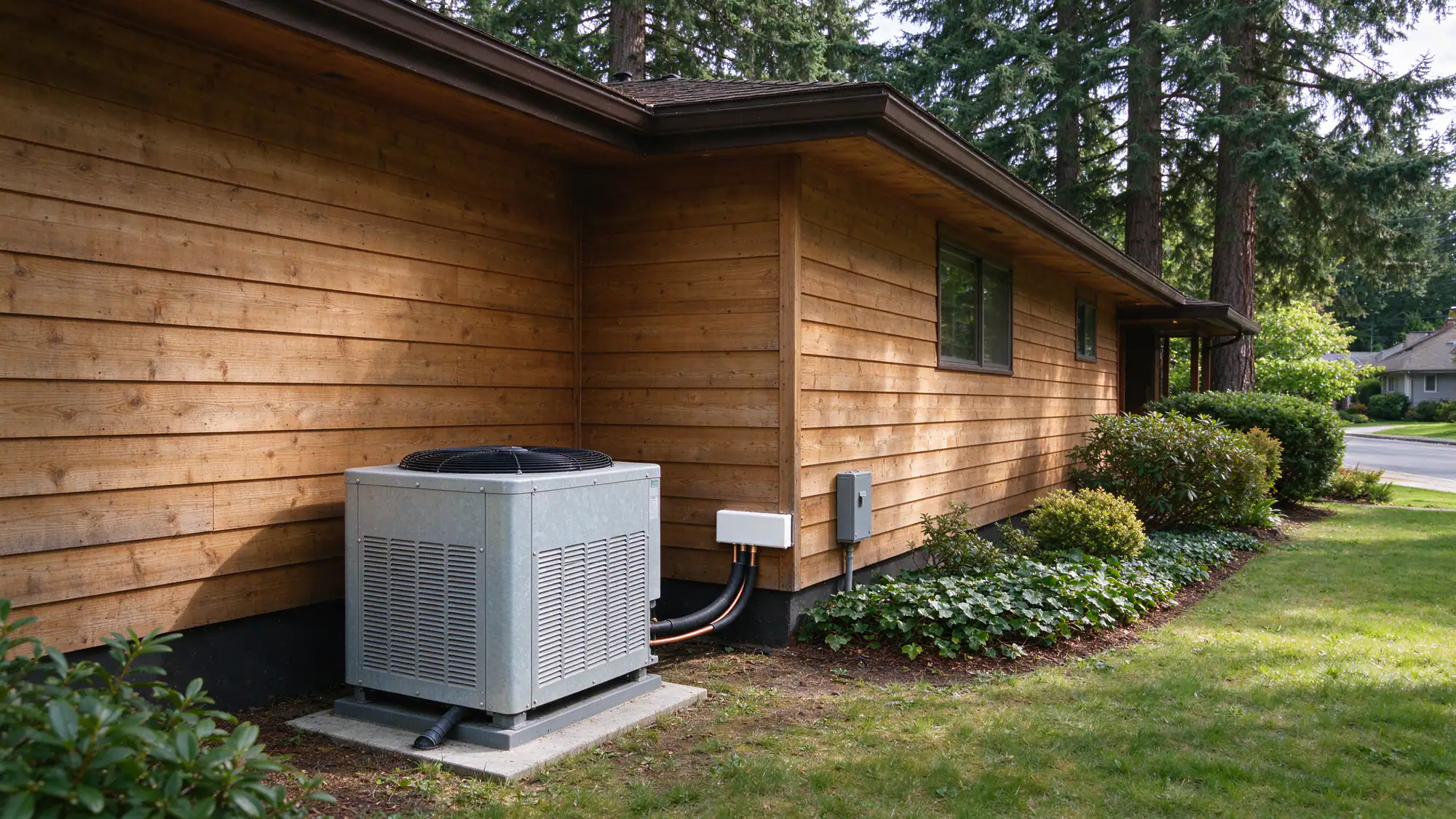
Bellevue buys its electricity from Puget Sound Energy, not Seattle City Light, and that one fact changes the heat pump decision: on PSE rates, whether to keep the gas furnace as backup is a real economic question rather than a formality. The Seattle Heat Pump Company plans dual fuel and all-electric ducted heat pump systems for Bellevue houses, from Lake Hills and Newport to Somerset and Bridle Trails, and licensed and insured contractors install them under Bellevue permits.
Bellevue’s own permit records show how owners have been deciding. Over the latest three years of records, the city logged 2,584 mechanical permits mentioning a heat pump, and 45% of them also listed a furnace, which points to heat pumps installed alongside gas furnaces. About 22% mentioned ductless or mini-split equipment.
The rate gap that shapes every Bellevue design
PSE’s average residential electric rate is about 20.6 cents per kWh, roughly 54% higher than City Light’s Seattle rate. PSE gas runs about $1.67 per therm. Put those through the arithmetic and a heat pump needs to average a coefficient of performance of about 3.4 to beat a 95% efficient gas furnace on energy cost. In Seattle the same break-even is about 2.2.
A heat pump’s efficiency falls as the outdoor temperature drops, because it has to pull heat from colder air. A good variable-speed unit can exceed 3.4 in the mild 40s and 50s that make up much of a Puget Sound winter, then drop below it on frosty nights. That is the mechanism behind dual fuel: let the heat pump run while it is the cheaper source, and let the furnace take over when it is not. The heat pump vs gas furnace guide works through the comparison for both utilities.
Rates are also moving. PSE has requested further increases of 17.75% on electricity and 12.93% on gas; those requests are not approved. Because both fuels would rise, the gap would not close by itself.
Choosing between dual fuel and all-electric
Bellevue’s housing makes the choice concrete. About a third of homes date from the 1960s and 1970s, by Census counts, and fewer than 1% predate 1940. Houses of that era were commonly built with forced-air gas furnaces, and about 46% of Bellevue households still heat with gas.
When dual fuel makes sense
A dual fuel heat pump adds a heat pump and a matched coil to the existing furnace. It fits best when the furnace has years of life left and a blower strong enough for heat pump airflow, and when the owner wants the lowest energy cost under PSE’s rate structure. The design sets a changeover temperature from the heat pump’s capacity and efficiency at each outdoor temperature and the house’s heat loss. The backup heat settings guide explains how that setting is chosen and why pushing it too high wastes the heat pump. PSE’s hybrid heat pump rebate of $1,500, or $2,400 with its income-based boost, applies to this configuration for customers with both PSE gas and electric service, which describes a gas-heated Bellevue house.
When all-electric makes sense
Retiring the furnace for an electric air handler suits houses where the furnace is near the end of its life, where the owner wants to close the gas account, or where solar or efficiency upgrades change the cost picture. It costs more to run than dual fuel at today’s PSE rates on the coldest days, so the design leans on a high-efficiency heat pump sized to carry the house at Bellevue’s 24°F design temperature with minimal resistance backup. PSE’s $4,000 income-qualified gas-to-heat-pump rebate applies to qualifying households that remove or cap the gas equipment. See furnace to heat pump conversion for the full scope.
Either path brings cooling, which is often the reason Bellevue owners start. Sea-Tac’s cooling degree days have nearly doubled since the 1990s, and a heat pump delivers central air through the same ducts; our central air alternative page explains the overlap.
Bellevue’s permits and siting rules
Bellevue runs its own permit office, and its rules differ from Seattle’s in ways that affect the design.
| Item | Bellevue | Seattle, for comparison |
|---|---|---|
| Heat pump permit | Mechanical permit from Bellevue Development Services | Refrigeration permit from SDCI, plus furnace permit when indoor equipment changes |
| Electrical permit | Issued by Bellevue when wiring or service changes | Issued by SDCI |
| Noise limit at residential line | 55 dBA day, 45 dBA night, enforced on complaint | 55 dBA day, 45 dBA night, side-yard noise review at permit |
| Equipment location | New homes and additions over 1,000 sq ft: rear yard, at least 5 ft from the line; side yards need screening | Side-yard units pass review at 47 dBA predicted or less |
| Utility rebates | PSE, Trade Ally installer required | City Light contractor discount |
Because Bellevue enforces noise on complaint rather than checking it at inspection, a unit can pass final and still draw a complaint later. The safer approach is to site and select equipment as if the limit were checked at the property line on day one.
Sizing, ducts and commissioning
Bellevue’s design temperatures match Seattle’s: 24°F for heating and 83°F for cooling in the energy code tables. Each system is sized from a room-by-room Manual J load, not from the furnace’s nameplate, since furnaces of the 1960s and 1970s were often oversized and many houses have since been insulated. The ducts get a static pressure test, because a heat pump needs more airflow than a furnace and older returns are often the bottleneck. At commissioning, airflow, refrigerant charge, defrost and the dual fuel changeover or backup lockout are verified and documented. The ducted heat pump installation page covers each step.
Since January 1, 2026, Washington requires new residential heat pumps to use refrigerants with a global warming potential under 750, which matters when replacing an older R-410A system; see heat pump replacement.
Rebates without Seattle’s programs
Seattle Clean Heat and City Light’s contractor discount stop at the City Light territory line. Bellevue owners work with PSE’s programs instead, and since April 2, 2026, PSE requires a Trade Ally installer for its rebates. Federal 25C tax credits ended for equipment placed in service after December 31, 2025. The PSE heat pump rebate guide keeps the current amounts. For the few Bellevue homes still on oil, about 0.6%, tank decommissioning runs through a Bellevue construction permit and an ICC-certified decommissioner. North of SR 520, Kirkland and Redmond share PSE economics but not always Bellevue’s design temperature.
Around Bellevue
Neighborhoods
- Lake Hills
- Northeast Bellevue
- Cougar Mountain/Lakemont
- Newport
- Somerset
- West Bellevue
- Bridle Trails
- Eastgate
- Bellevue Downtown Park
- Kelsey Creek Farm
- Lake Sammamish shoreline
- Mercer Slough Nature Park
- I-405
- I-90
- SR 520
- 148th Ave NE
- Bellevue Way
- Puget Sound Energy (electric and gas)
- City of Bellevue Development Services (mechanical and electrical permits)
Services in Bellevue
Bellevue heat pump questions
How much does a ducted heat pump cost in Bellevue?
Seattle-area ducted heat pumps on usable ducts typically run about $6,700 to $20,000, and Bellevue projects are budgeted from the same range. Adding a heat pump to a furnace for dual fuel is priced from the furnace's condition and the coil fit. Duct and electrical work move the number. These are budgeting ranges, not quotes.
Is a heat pump cheaper to run than gas in Bellevue?
It is closer than in Seattle. On PSE's current rates, about 20.6 cents per kWh and $1.67 per therm, a heat pump has to average a coefficient of performance of about 3.4 to beat a 95% furnace on energy cost. Efficient units can do that in mild weather but fall below it on cold nights, which is the case for dual fuel.
Which PSE rebates apply to a Bellevue heat pump?
A hybrid rebate of $1,500, or $2,400 with the income-based boost, for adding a heat pump to a gas furnace; the same amounts for replacing electric-resistance heat; and $4,000 for income-qualified gas-to-heat-pump conversions. Since April 2, 2026, the installer must be a PSE Trade Ally. Seattle's city programs do not apply.
Does Bellevue require a permit for a heat pump?
Yes. Bellevue requires a mechanical permit to install or replace a heat pump, and an electrical permit when wiring or the service changes. Bellevue issues both itself; Seattle's SDCI is not involved. The city enforces its 55 dBA day and 45 dBA night noise limits on complaint rather than at inspection, so siting matters after the final too.
Where can the outdoor unit go on a new Bellevue home or addition?
For new homes and additions over 1,000 square feet, Bellevue's land use code puts mechanical equipment in the rear yard at least 5 feet from the property line. Side-yard installations need sound screening. Replacing a unit at an existing house is a different situation, but the noise limits at the property line still apply.
Related guides
Nearby service areas
Plan a heat pump for your Bellevue houseTell us about the house and the system you have now.
Get an Estimate